
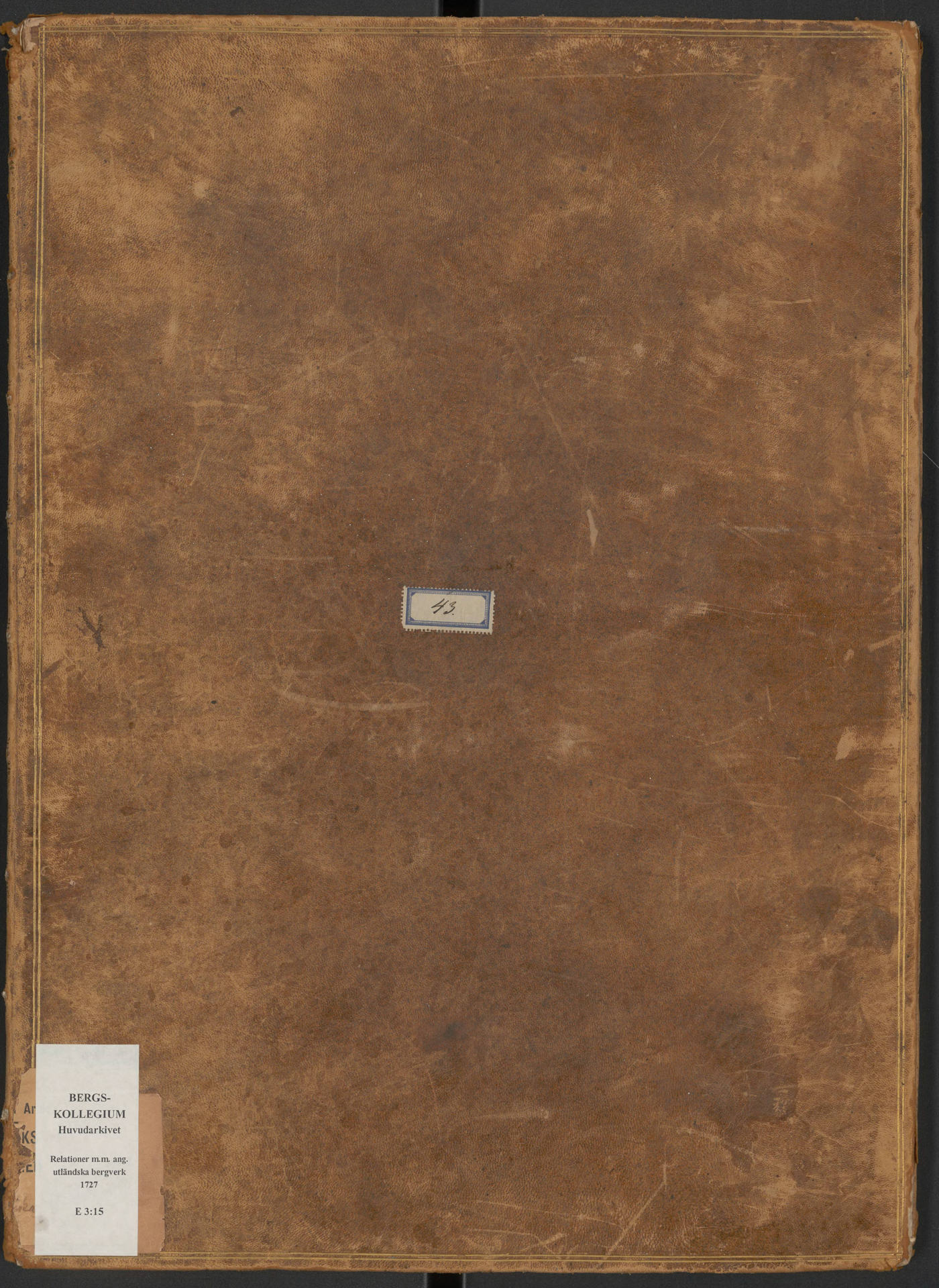
 Download plain text
G. Brandt (1727)
Data quality
- The transcription has not been fully proofread and may contain OCR errors.
- Place names in the text have not been systematically marked.
- Marked places may not yet be linked to coordinates in the gazetteer.
- Illustrations may be incomplete or not yet reviewed.
- This volume has not been editorially approved for publication.
This report was compiled by Georg Brandt (1694–1768), one of the most accomplished Swedish mining officials and natural philosophers of the early eighteenth century. Although best known today as the chemist who identified cobalt as a distinct metallic substance, Brandt's contemporaries recognised him equally as a skilled mathematician, surveyor and mining expert. Educated within the Swedish mining administration and later employed by Bergskollegium, he belonged to a generation that sought to unite chemical knowledge, practical mining experience, mathematical reasoning and mechanical expertise in the service of the Swedish state.
The present manuscript accompanied Brandt's report on the mining districts of the Harz Mountains, submitted to Bergskollegium following his journey of 1727. Unlike many of the travel reports preserved in the archive, the surviving material consists primarily of maps, plans, sections and technical drawings rather than a continuous narrative account. The volume therefore offers a rare visual record of one of Europe's most important mining regions during the early eighteenth century.
The illustrations focus particularly on the mining centres of Clausthal, Zellerfeld, Andreasberg, Lautenthal, Wildemann and neighbouring districts of the Upper Harz. They include plans of underground workings, shafts, drainage systems, pumping installations, ore-dressing works (Pochwerke), washing facilities and other elements of mining infrastructure. Several drawings show mine layouts and water-management systems, while others survey entire mining landscapes and their associated industrial installations.
A distinctive feature of the manuscript is its emphasis on visual representation as a means of producing and communicating knowledge. The drawings do not merely illustrate mines described elsewhere in the report; they constitute a form of technical expertise in their own right. Through plans, sections and measured depictions of machinery and mine workings, Brandt translated mining practice into a graphical and mathematical language that could be transmitted, studied and compared.
Further reading:
Jacob Orrje, Mechanicus: Performing an Early Modern Persona (Uppsala, 2015).
Hjalmar Fors, The Limits of Matter: Chemistry, Mining, and Enlightenment (Chicago, 2015).