

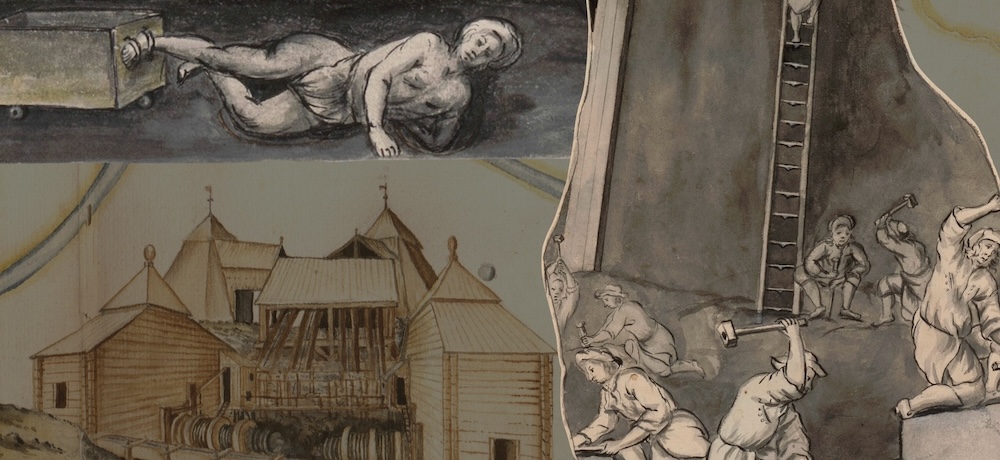


Early modern mines were like subterranean roots from which fiscal-military states drew military, economic, and scientific power. To improve this vital trade, fledgling European mining administrations encouraged travelling officials to tour foreign territories to collect new useful knowledge. This website presents the work of the mining history research group, based at the Department of History at Uppsala University. The group uses state-of-the-art digital methods to explore the transnational and environmental history of the Swedish mining administration 1600–1900. Read more about our research projects
Latest news
-
Funding for new project
Måns Jansson and Jacob Orrje have been awarded funding for from the Swedish Research Council for the project "The Administrative Life of Environmental Problems: Governing Material Flows in the Swedish Metal Industry 1750–1900" (2027–29)
-
Workshop on the environmental history of mining and metal making, 20 April 2026
On 20 April 2026, Orrje and Jansson participated at a workshop at Jernkontoret in Stockholm for discussing environmental history of mining and metal making.
-
Digital History seminar at SU, 21 October 2025
On 25 October 2025, Orrje presented the draft paper: "Datamining the Swedish Bureau of Mines: Experiments with distant reading in an early modern administrative archive", analyzing the minutes and travelogues of the Bureau of Mines using LLM:s and text-mining methods.
-
Subterranean Supervision. Codification of Miners’ Techniques in the Bergskollegium, 1620–1750, 27–30 March 2025
On the 27–30 March 2025, Orrje presented his paper "Subterranean Supervision. Codification of Miners’ Techniques in the Bergskollegium, 1620–1750" at the workshop "Knowing in Action", arranged by Simon Schaffer (Cambridge) and Lissa Roberts (Twente).