
 Download plain text
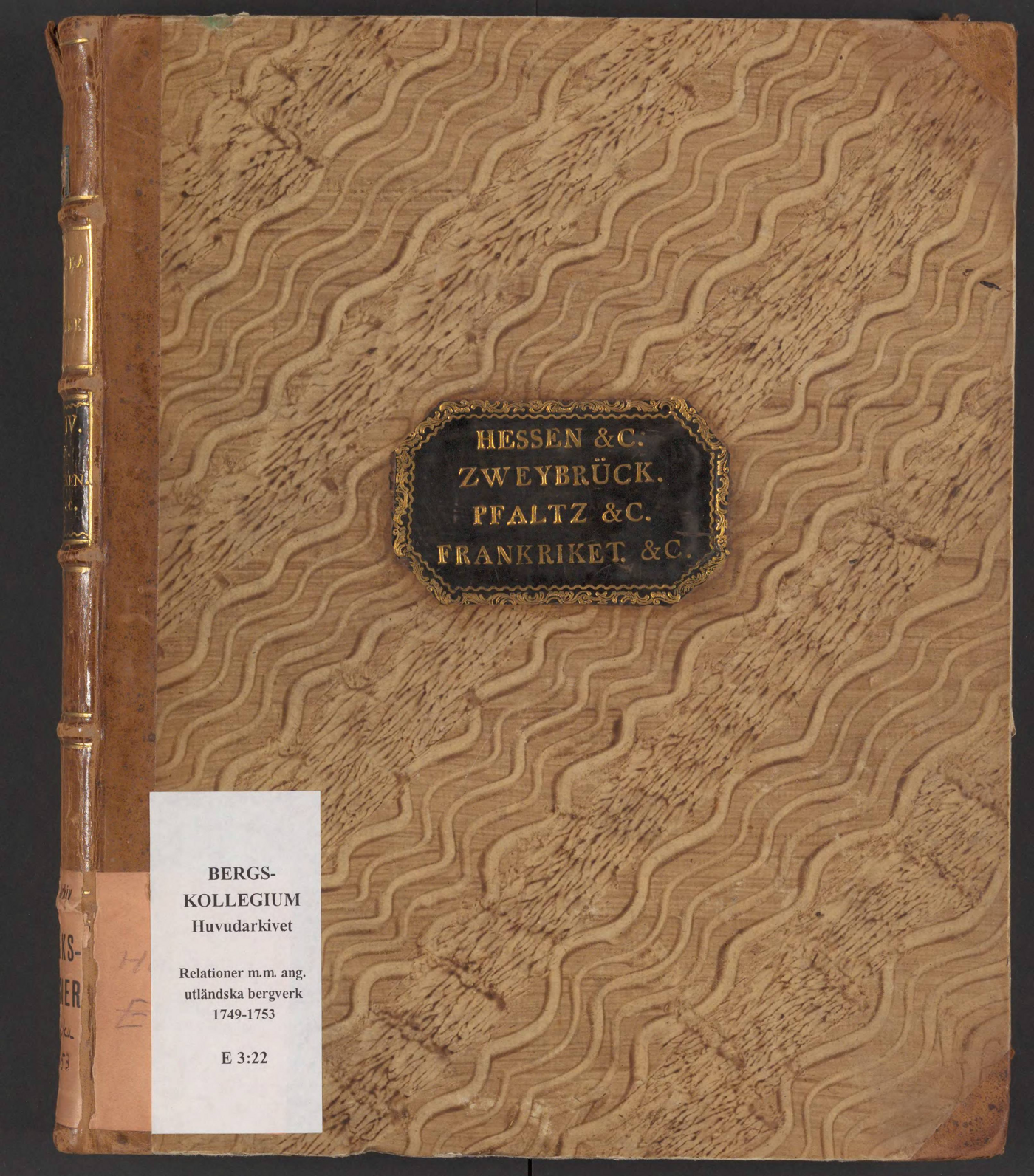
Alexander Funck Bd. 4 (1749 - 1750 och 1752 - 1753)
Data quality
- The transcription has not been fully proofread and may contain OCR errors.
- Place names in the text have not been systematically marked.
- Marked places may not yet be linked to coordinates in the gazetteer.
- Illustrations may be incomplete or not yet reviewed.
- This volume has not been editorially approved for publication.
This report forms the fourth volume of Alexander Funck's (1716–1797) extensive survey of European mining districts. Whereas the preceding volumes focused on the Harz Mountains, Saxony, Bohemia and the Ore Mountains, the present manuscript follows Funck westward into the mining and industrial regions of Hesse, the Rhineland, Alsace, Lorraine, Württemberg, Fürstenberg, Brisgau, and eastern France. It therefore marks a geographical shift from the great silver, tin and cobalt districts of central Europe to regions where mining was more dispersed and where mining, manufacturing, fuel extraction and industrial chemistry often played a larger role than large-scale precious-metal production.
Like the earlier reports, the volume was written by a mining official whose interests extended well beyond individual mines. Yet this manuscript differs noticeably from Funck's previous works. The Harz volume concentrated on mine engineering and underground construction, while the Saxon and Bohemian reports were dominated by questions of ore geology, mineral processing and metallurgy. Here Funck's attention broadens again. Mining remains central, but he also investigates saltmaking, brass manufacture, mercury production, coal mining, industrial chemistry, stone quarrying, lapidary industries and even the manufacture of Hessian crucibles. The report therefore provides a particularly rich picture of the wider industrial economy associated with mining regions.
The manuscript opens with extensive descriptions of mining districts in Hesse, including Smalkalden, Riegelsdorf, Frankenberg and Meissner. Funck examines copper, cobalt and iron mining, salt production, coalfields and alum works, paying close attention to geological formations, ore deposits and mining methods. Particularly noteworthy are his discussions of the Meissner coal mines and the organisation of large-scale saltmaking operations, topics that receive comparatively little attention in his other travel reports.
A second major theme is the extraction and processing of industrial minerals. The report contains detailed descriptions of cobalt mining, mercury deposits, calamine mining for brass manufacture, sulphur and vitriol production, and the preparation of pigments and chemical substances. Funck follows materials from mine to workshop, describing not only extraction but also roasting, smelting, distillation and refining processes. These sections are especially valuable because they document industries that occupied an important place in eighteenth-century manufacturing but are often less visible than silver or copper mining.
The volume also stands out for its attention to artisanal technologies. Funck provides unusually detailed accounts of the Oberstein agate-cutting industry, crystal grinding in Waldkirch and Freiburg, gypsum quarrying near Paris, and the large brass works around Aachen and Stolberg. In contrast to earlier manuscripts, these sections extend well beyond mining proper and explore the transformation of raw materials into finished products through specialised craft production.
Another distinctive feature is the strong presence of fuel and industrial infrastructure. Coal mining at Meissner and near Liège occupies a significant part of the report, reflecting Funck's growing interest in the relationship between mineral extraction, fuel supply and industrial production. Discussions of drainage, transport, labour organisation and mine financing are interwoven with detailed geological observations, illustrating the practical conditions necessary for sustained industrial activity.
Compared with the previous volume on Saxony and Bohemia, which centred on the geology of ore deposits, this manuscript is less concerned with mining science in the narrow sense and more attentive to the diverse uses of mineral resources. The report repeatedly moves between mines, manufacturing sites, chemical works and workshops, tracing how different materials entered wider systems of production and exchange. In this respect it anticipates some of the broader economic interests that would later characterise Swedish cameral and commercial investigations of industry.
Taken together, the four travel reports reveal the remarkable breadth of Funck's interests. If the Harz volume explored mining engineering, the Saxon volume mining systems, and the Bohemian volume ore geology and mineral processing, this fourth report expands the perspective further still by examining the wider industrial landscape of western Europe. It therefore provides an unusually comprehensive account of the connections between mining, manufacturing, fuel, chemistry and material production in the middle decades of the eighteenth century.