
 Download plain text
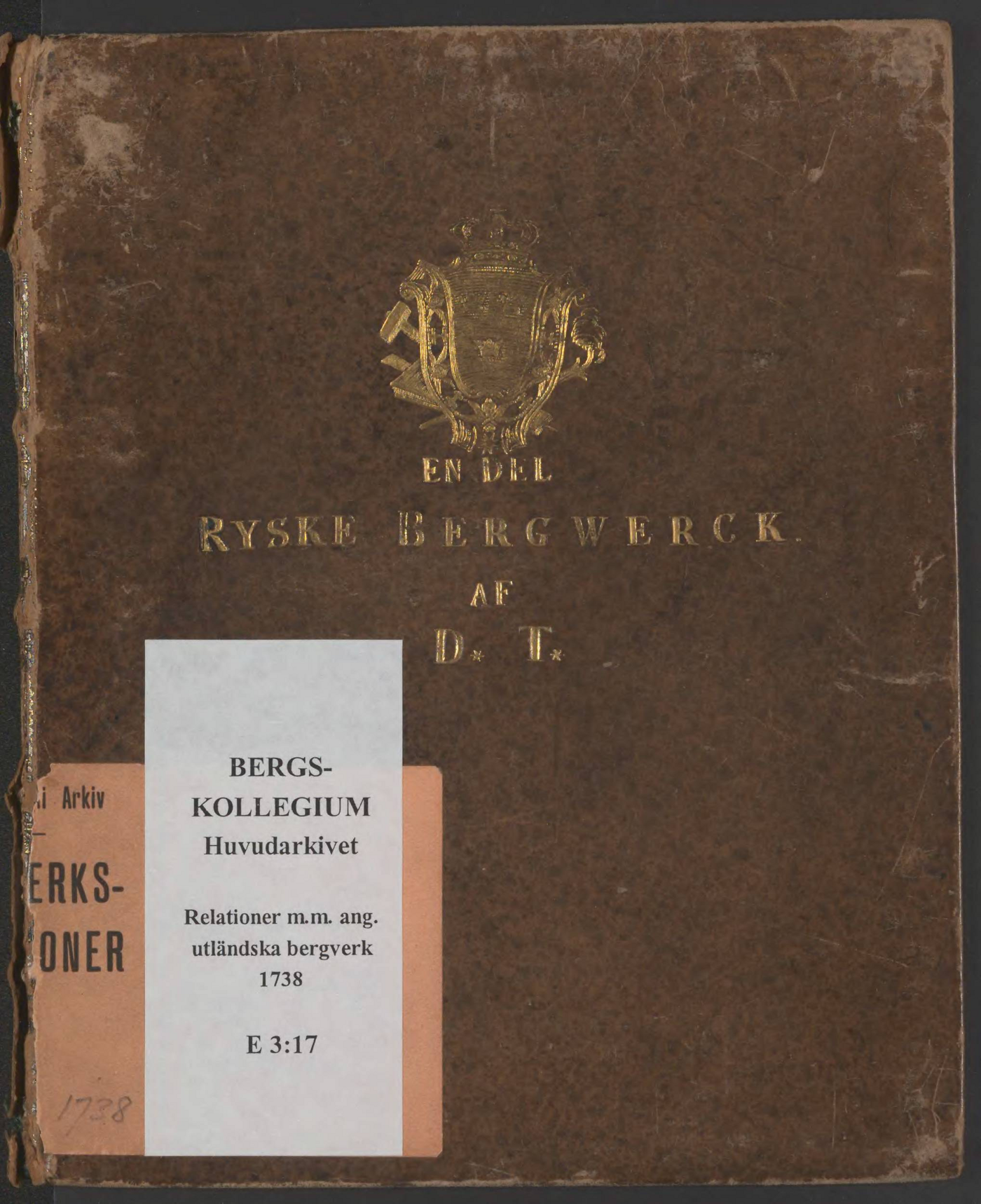
Daniel Tilas (1738)
Data quality
- The transcription has not been fully proofread and may contain OCR errors.
- Place names in the text have not been systematically marked.
- Marked places may not yet be linked to coordinates in the gazetteer.
- Illustrations may be incomplete or not yet reviewed.
- This volume has not been editorially approved for publication.
This report was compiled by Daniel Tilas (1712–1772), an influential Swedish mining official and mineralogist. Trained within Bergskollegium and later renowned for his geological investigations, mining surveys and extensive mineral collections, Tilas played a central role in the development of Swedish mining science during the Age of Liberty.
Like many of the officials employed by Bergskollegium during the eighteenth century, Tilas combined practical mining and metallurgical expertise with a strong interest in geology, administration, economic policy and the comparative study of mining regions. His report belongs to a broader tradition of state-sponsored knowledge gathering, in which Swedish mining officials travelled in order to investigate foreign industries, collect technical information and assess the economic and institutional conditions that shaped mining production.
The present report describes a journey undertaken during the spring of 1738 through territories that had recently passed from Swedish to Russian control. Travelling from Viborg and St Petersburg into Ingermanland, Karelia and the Olonets region, Tilas investigated mines, ironworks, copper works and metallurgical establishments operating under Russian administration. The report therefore provides a valuable Swedish perspective on the development of Russian mining in regions that had formerly belonged to the Swedish sphere of influence.
The report opens with a detailed examination of the abandoned copper mines at Krasnoe Selo near St Petersburg. Tilas reconstructs the history of earlier Swedish and Russian attempts to exploit the deposits and carefully evaluates the geology of the site. He provides descriptions of the local rock formations, sulphide-bearing strata and ore occurrences, concluding that previous expectations of profitable copper production had been exaggerated and that the renewed Russian investigations were unlikely to prove successful.
A second major theme concerns Russian state-sponsored mining and metallurgy. Tilas devotes considerable attention to the brass works at Krasnoe Selo, the iron and copper works at Systerbeck, and the mining and smelting complex at Kontzoser in the Olonets region. He records furnaces, smelting processes, iron production, arms manufacture, copper extraction and ore dressing, but is equally interested in labour organisation, transport costs, fuel supplies, administrative arrangements and the financial performance of the enterprises. Throughout the report he repeatedly evaluates whether these works could realistically operate at a profit.
Particularly extensive sections describe the copper mines around Kontzoser, including Nadeschda, Neuer Segen Gottes, Römische Adler, Nizelski and several other newly opened workings. Tilas analyses the structure of ore veins, host rocks, fault systems and mineral associations, recording observations on copper ores, sulphides, quartz, calcite and gangue minerals. These discussions reveal his growing interest in geological interpretation and the relationships between ore deposits and surrounding rock formations.
A distinctive feature of the report is its concern with mining administration and state policy. Tilas repeatedly assesses Russian efforts to develop mining through imported German and Saxon expertise, commenting on the effectiveness of foreign specialists, the training of local personnel, and the prospects for creating a durable Russian mining sector. In this respect the manuscript is as much an investigation of institutions and knowledge transfer as it is a technical account of mines and smelting works.
The report concludes with broader observations on Russian mining, including silver prospects on Berezov Island, copper discoveries in northern Karelia, and iron production in Siberia. The result is an unusually wide-ranging survey of Russian extractive industries during a period of rapid expansion under imperial patronage. Viewed from a Swedish perspective, the manuscript offers insight not only into individual mines and works, but also into the larger question of how states sought to develop mineral resources, technical expertise and industrial production during the eighteenth century.