
 Download plain text
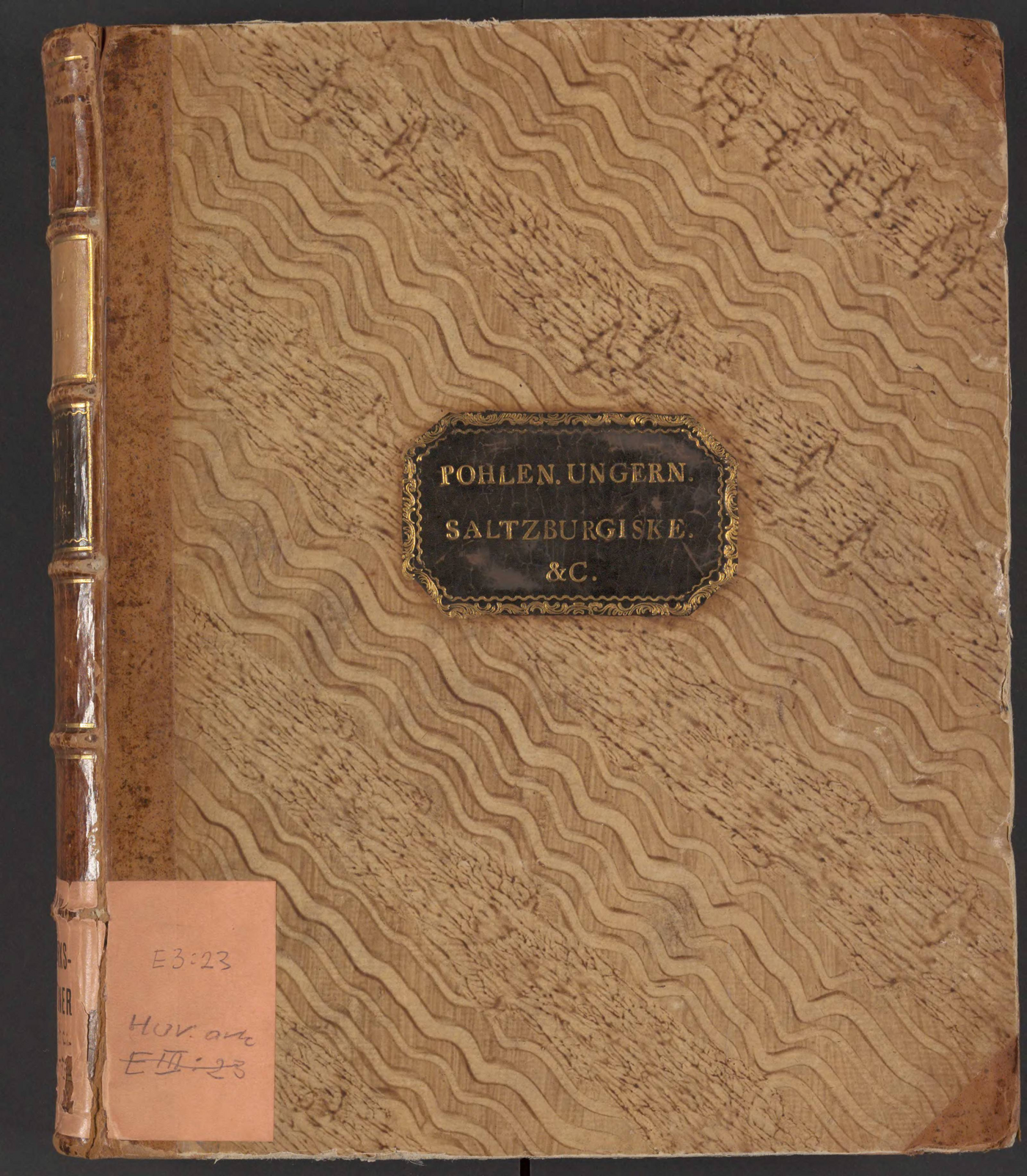
Alexander Funck Bd. 5 (1750)
Data quality
- The transcription has not been fully proofread and may contain OCR errors.
- Place names in the text have not been systematically marked.
- Marked places may not yet be linked to coordinates in the gazetteer.
- Illustrations may be incomplete or not yet reviewed.
- This volume has not been editorially approved for publication.
This fifth and final volume of Alexander Funck's (1716–1797) foreign travel reports brings his long survey of European mining districts to a close. While the earlier volumes focused on the Harz, Saxony, Bohemia, western Germany and France, the present manuscript centres on the great mining regions of Poland, Upper and Lower Hungary, Styria, Bavaria and the Archbishopric of Salzburg. It is also the most ambitious of Funck's reports in terms of scale, combining observations on mining, metallurgy, mining administration, mechanical engineering, salt production and labour organisation across a vast geographical area.
The volume opens with reflections on the wider significance of mining travel and on the importance of studying foreign mines as a means of improving Swedish mining practice. Unlike many earlier Bergskollegium travellers, Funck repeatedly moves beyond description to discuss the institutional conditions required for successful mining. He devotes considerable attention to mining administration, foreign study travel, technical education and the need to maintain a continuous supply of skilled mining personnel. In this respect the manuscript reads less like a travel report than a sustained reflection on mining policy and the organisation of mining knowledge.
A major section is devoted to the famous salt mines of Wieliczka and Bochnia in Poland. Funck describes the geological structure of the salt deposits, the organisation of underground chambers, the extraction of large blocks of rock salt, drainage systems, transport arrangements and labour organisation. These chapters contain some of the most detailed discussions of salt mining found anywhere in the corpus of Bergskollegium travel reports and provide a unique account of one of Europe's most celebrated mining enterprises.
The largest portion of the manuscript concerns the mining districts of Schemnitz (Banská Štiavnica), Kremnitz (Kremnica) and Neusohl (Banská Bystrica) in Upper Hungary. Here Funck examines the famous gold, silver and copper deposits of the Habsburg monarchy. He discusses ore veins, underground mining methods, mine drainage, smelting processes, ore dressing, amalgamation, gold extraction, silver refining and the operation of large state-owned mining enterprises. Particularly noteworthy are his detailed observations on mining administration and the training of mining officials, including the system of practical instruction provided to young mining apprentices.
One of the most distinctive features of the volume is its extensive discussion of mining machinery. Funck devotes considerable space to drainage systems, pumping technology and mechanical innovation, including descriptions of steam engines, hydraulic machinery and the celebrated pumping experiments undertaken in the Hungarian mines. Compared with the earlier volumes, this manuscript contains the greatest concentration of material on large-scale mining engineering.
The report also surveys the gold-mining districts of Gastein in Salzburg, the copper mines of Schwaz and Schmolnitz, the mercury mines of Idria, the iron-producing regions of Styria, and a range of smaller mining enterprises throughout the eastern Alps. Throughout these sections Funck compares the organisation of mining communities, the use of natural resources, and the economic foundations of mining production.
Unlike the preceding volumes, this manuscript opens with an extended methodological reflection on mining knowledge, technical expertise, state support and the education of mining officials, themes that frame the subsequent descriptions of the mining districts of Poland, Hungary, Styria and Salzburg.
Taken together, Funck's five travel reports document an extraordinary survey of European mining at mid-century. This final volume serves as both a culmination and a synthesis, bringing together questions of geology, engineering, metallurgy, administration and labour while reflecting on the broader conditions under which mining knowledge, institutions and technical expertise could flourish.