
 Download plain text
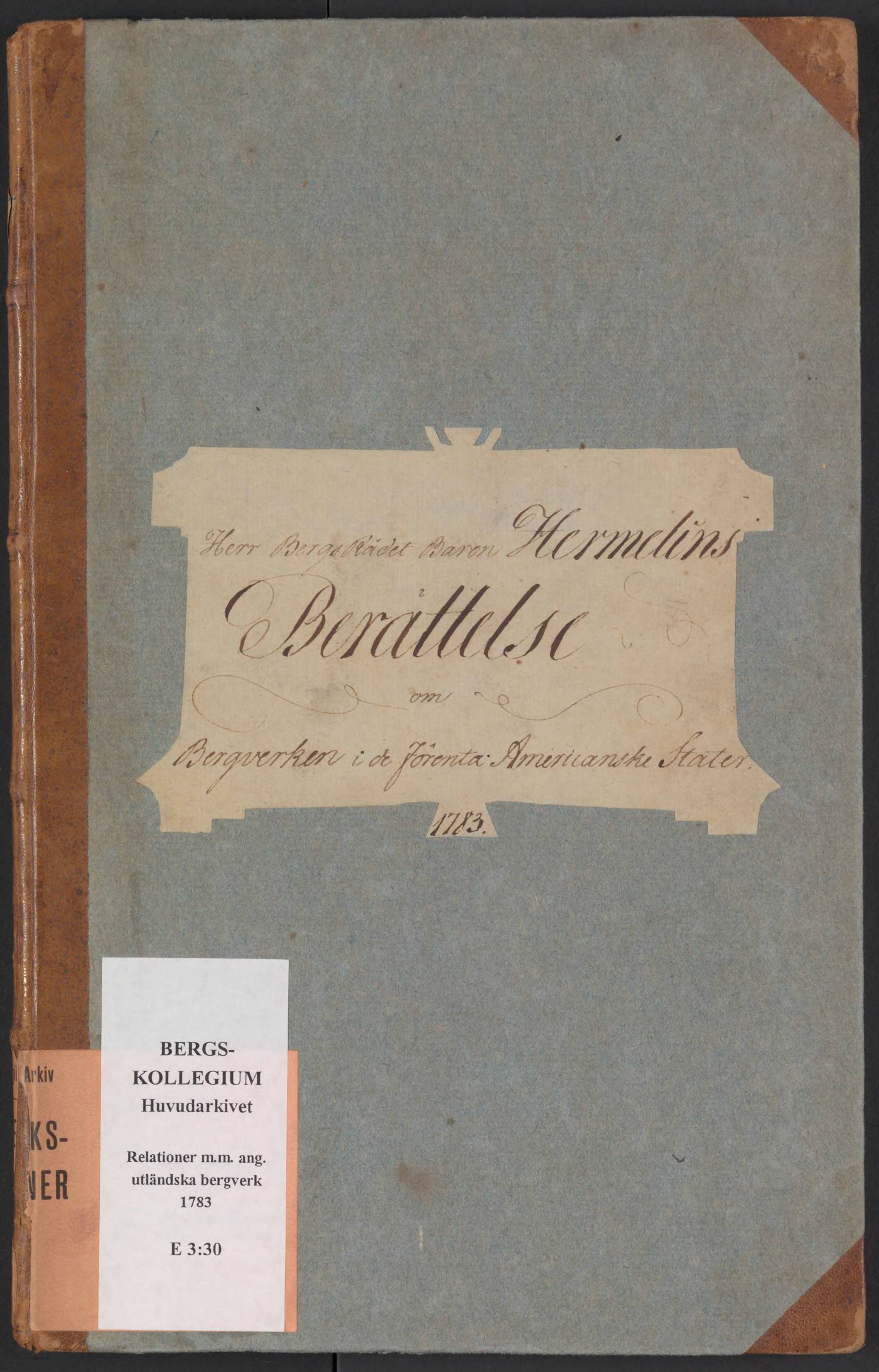
S. G. Hermelin (1783)
Data quality
- The transcription has not been fully proofread and may contain OCR errors.
- Place names in the text have not been systematically marked.
- Marked places may not yet be linked to coordinates in the gazetteer.
- Illustrations may be incomplete or not yet reviewed.
- This volume has not been editorially approved for publication.
This report was compiled by Samuel Gustaf Hermelin (1744–1820), one of the most prominent Swedish economic reformers, industrial entrepreneurs and mining officials of the late eighteenth century. Educated at Uppsala University and employed in Bergskollegium from the 1760s, Hermelin travelled extensively in Europe before becoming deeply involved in mining, iron production and economic development in northern Sweden. He is particularly remembered for his ambitious efforts to promote mining, ironworks, settlement, communications and mapping projects in Norrland. Unlike earlier Bergskollegium travellers, whose principal task was to collect technical information about foreign mining regions, Hermelin combined interests in mining, commerce, industry and economic policy on a much broader scale.
The present report, submitted to Bergskollegium in 1802, concerns the mining and iron industry of the United States during the decades following American independence. Much of the material derives from observations made in Pennsylvania, New Jersey, Maryland, Virginia and neighbouring states. The report is among the earliest extensive Swedish descriptions of American mineral production and industrial development, and reflects the growing Swedish interest in the economic potential of the new republic.
Unlike the travel reports of Alexander Funck or Reinhold Angerstein, the manuscript is not primarily organised around individual mines. Instead, Hermelin surveys entire regions, comparing mineral resources, industrial output, labour costs, transport systems, exchange rates, production costs and commercial conditions. A central concern throughout the report is the relationship between natural resources and industrial growth. He repeatedly considers how access to ore, forests, charcoal, coal, labour and markets shaped the development of American iron production.
Particularly detailed sections are devoted to the iron-producing districts of Pennsylvania, New Jersey and Maryland. Hermelin describes numerous mines and ironworks, including the famous deposits at Warwick, Cornwall, Hopewell, Hibernia, Mount Hope and Andover. He discusses the geological character of iron ores, distinguishing between vein deposits and stratified ore bodies, and records ore quality, mining methods, transport costs and production expenses.
A distinctive feature of the report is its close attention to industrial organisation. Hermelin systematically calculates the costs of ore extraction, charcoal production, transportation, labour and smelting. He compares different methods of ironmaking, including blast furnaces, bloomery forges, German-style refining, English-style ironworking and rolling mills. Particular attention is given to the economics of production, the availability of timber and charcoal, and the growing importance of coal and manufactured iron goods within the American economy.
The report also contains extensive observations on labour systems. Hermelin discusses wage labour, indentured servants and enslaved labour, especially in Maryland and Virginia, comparing labour costs, maintenance expenses and productivity in considerable detail. These discussions make the manuscript valuable not only for the history of mining and metallurgy but also for the social history of labour in the early United States. Read alongside modern scholarship on slavery and racialised labour regimes, Hermelin's calculations and descriptions provide insight into the ways in which enslaved workers formed part of the economic foundations of the American iron industry in the decades following independence. They are particularly significant in light of Hermelin's later involvement in schemes for mining expansion, settlement and resource exploitation in northern Sweden and Sápmi, where questions of labour, natural resources and territorial development likewise occupied a central place in his thinking. The manuscript is therefore an important source not only for industrial history, but also for understanding the relationship between extraction, labour organisation and frontier development in the late eighteenth-century Atlantic world.
More broadly, the report reflects Hermelin's characteristically reformist outlook. Rather than merely describing industrial techniques, he repeatedly evaluates their economic significance and considers how resources, institutions and infrastructure contributed to national prosperity. In this respect the manuscript differs markedly from earlier Bergskollegium travel accounts and belongs as much to the tradition of political economy as to that of mining science. It provides an important Swedish perspective on American industrial development at the turn of the nineteenth century and illustrates the widening scope of technical and economic observation in the decades after the Enlightenment.