
 Download plain text
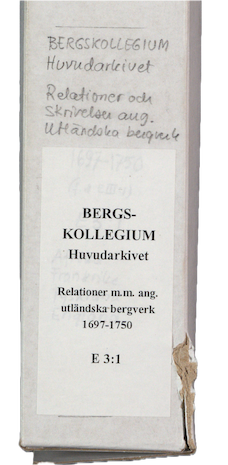
Correspondence on Mining (1697-1750)
Data quality
- The transcription has not been fully proofread and may contain OCR errors.
- Place names in the text have not been systematically marked.
- Marked places may not yet be linked to coordinates in the gazetteer.
- Illustrations may be incomplete or not yet reviewed.
- This volume has not been editorially approved for publication.
This volume contains a diverse collection of correspondence, memoranda and reports concerning mining, metallurgy, trade and industrial development assembled by the Swedish Bureau of Mines (Bergskollegium) between approximately 1697 and 1750. Unlike the travel reports preserved elsewhere in the collection, the manuscript is not the work of a single author. Instead, it brings together letters, technical descriptions, diplomatic intelligence, project proposals and excerpts from official communications originating from Sweden, England, France, North Africa and other parts of Europe.
The documents reveal how information circulated through the networks of Bergskollegium during the eighteenth century. Mining officials, diplomats, travellers, merchants and foreign entrepreneurs reported on new technologies, mining enterprises, industrial projects and commercial opportunities. Many of the texts were transmitted through Swedish diplomatic representatives abroad and subsequently copied, translated or circulated within the administration. The volume therefore provides valuable insight into the processes through which technical and economic knowledge was gathered, evaluated and incorporated into state decision-making.
Several recurring themes run throughout the collection:
Foreign Mining and Metallurgy
The volume contains numerous descriptions of mining districts, ironworks, copper works and metallurgical installations in England, France, Germany and elsewhere. Reports by travellers such as Henric Kalmeter, Anders Swab, Jacob Hertzen, Carl Mallmén and other mining officials discuss smelting methods, ore deposits, mining machinery, bookkeeping practices, labour costs, ore dressing and metallurgical processes. These texts document Swedish efforts to monitor developments in the principal mining regions of Europe.
Intelligence on Industrial Competition
A particularly important subject is the international iron trade. The correspondence repeatedly addresses English attempts to reduce dependence on Swedish iron and to develop alternative sources of supply through domestic production, Russian imports and colonial mining ventures. Considerable attention is devoted to debates over ironmaking with coal, including the well-known projects associated with Wood, as well as concerns about Russian iron exports and American iron production. These materials illuminate contemporary perceptions of international competition in the iron trade during the first half of the eighteenth century.
Mining Projects and Technical Proposals
The volume also preserves a series of ambitious industrial schemes and invention proposals. Among the most remarkable is the 1748–1749 memorial submitted by the English economic writer Malachy Postlethwayt, who offered the Swedish Crown an allegedly revolutionary method for producing superior cast iron and iron ordnance. Detailed explanatory material accompanies the proposal, illustrating how Bergskollegium and the Swedish government evaluated foreign inventions and technological claims.
Diplomatic and Commercial Information Gathering
Many documents originated through Sweden's diplomatic service. Envoys and secretaries stationed in London, Paris, Tunis, The Hague and other centres regularly forwarded information concerning mining, metallurgy, tariffs, trade policy and industrial projects. The result is a vivid picture of eighteenth-century economic intelligence gathering. Rather than focusing solely on mines and technologies, these correspondents examined customs duties, commercial regulations, political decisions, labour markets, shipping patterns and industrial investment.
Sweden and the Wider Mining World
The collection is particularly valuable for understanding how Swedish officials viewed their country's position within a broader European and Atlantic economy. Repeated comparisons are made between Swedish, English, French, German and Russian production systems. Concern for the competitiveness of Swedish iron, copper and steel exports appears throughout the volume, reflecting Bergskollegium's wider effort to maintain Sweden's position as one of Europe's leading metal-producing states.
The documents gathered here reveal a side of Bergskollegium's activities that is less visible in the travel journals themselves. They demonstrate that mining expertise was not created through travel alone, but also through an extensive system of correspondence, translation, information gathering and bureaucratic exchange. The volume therefore offers an unusually rich illustration of how technical knowledge, commercial intelligence and state administration became increasingly interconnected during the eighteenth century.