
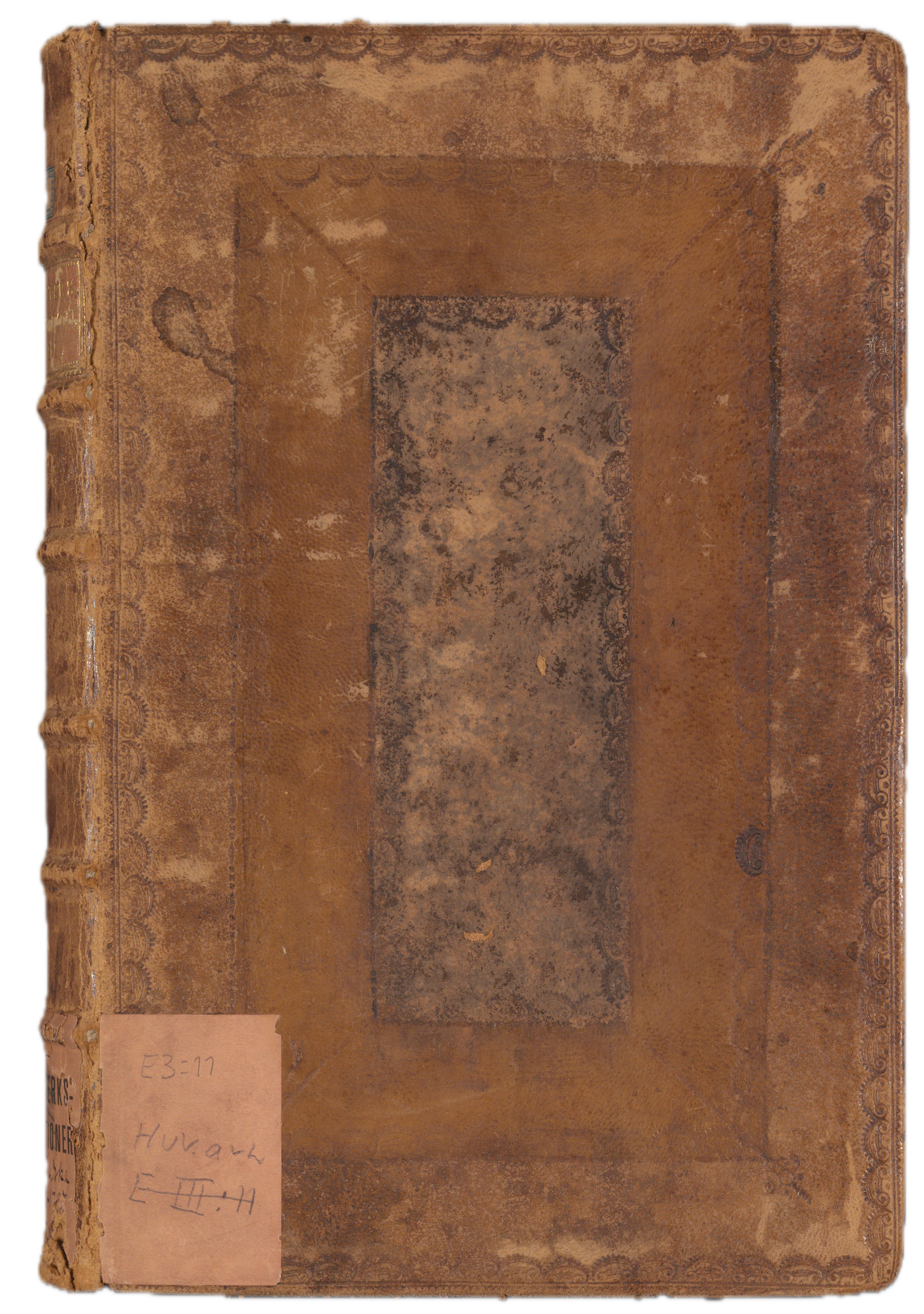
 Download plain text
Kalmeter's report of German mines (1718–1727)
Data quality
- The transcription has not been fully proofread and may contain OCR errors.
- Place names in the text have not been systematically marked.
- Marked places may not yet be linked to coordinates in the gazetteer.
- Illustrations may be incomplete or not yet reviewed.
- This volume has not been editorially approved for publication.
This report was compiled by Henric Kalmeter (1693–1750), one of the most accomplished mining travellers employed by the Swedish state during the early eighteenth century. Trained within Bergskollegium, Kalmeter spent almost a decade travelling through Britain and continental Europe, investigating mining, metallurgy and manufacturing on behalf of the Swedish mining administration. His reports rank among the most detailed technical surveys produced by any Swedish traveller of the period and formed part of a wider effort to collect practical knowledge for the benefit of Swedish mining and industry.
The present volume focuses on the mining and metallurgical regions of the German-speaking lands, Bohemia and the southern Low Countries. Unlike Kalmeter's report on England and France, which devotes considerable attention to manufacturing and trade, this manuscript is predominantly concerned with mining practice, ore processing and metallurgical technology. It combines detailed descriptions of individual mines with extensive observations on smelting, refining, labour organisation, production costs and mining administration.
Particularly extensive sections are devoted to the mining districts of the Saxon Ore Mountains (Erzgebirge), including Freiberg, Schneeberg, Johanngeorgenstadt, Eibenstock, Schwarzenberg and Joachimsthal. Kalmeter describes silver, tin, cobalt, bismuth, lead and copper mining, often recording the structure of individual mines, the disposition of galleries and shafts, pumping arrangements, ore dressing techniques and smelting procedures. His account of the silver and cobalt mines of Schneeberg and Johanngeorgenstadt is especially detailed, as are his observations on the tin mines of Schlackenwald and the silver mining districts of Freiberg and Joachimsthal.
A major theme throughout the report is the treatment of complex ores. Kalmeter discusses silver-lead smelting, copper production, cobalt processing for blue pigments, bismuth extraction, arsenic manufacture and tin smelting. He provides unusually detailed accounts of German and Bohemian smelting furnaces, roasting methods, segregation and cupellation processes, cobalt colour works, and the refining of silver-bearing copper and lead. The manuscript also contains lengthy descriptions of mining machinery, drainage systems, water-powered pumping devices, mine ventilation and ore preparation.
Beyond Saxony and Bohemia, Kalmeter surveys iron-producing regions in Hesse, Nassau, Westphalia, Luxembourg, Liège and other parts of central Europe. He records blast furnaces, finery forges, steel works, wire-drawing mills, slitting mills, brass works, lead mines, coal mines and alum works. Particularly notable are his detailed descriptions of steel production in the Siegerland and Sauerland districts, the brass industry around Aachen and Stolberg, and the ironworking regions of Hesse and Nassau.
A distinctive feature of the manuscript is its sustained concern with measurement and comparison. Writing before the emergence of modern systems of technical standardisation, Kalmeter repeatedly translated between local units of weight, volume, length and production used in different mining regions. Throughout the report he records the dimensions of mines and furnaces, the weights of ores and metals, transport capacities, labour costs and production outputs, while simultaneously explaining how local measures related to one another. The manuscript therefore offers valuable insight not only into mining and metallurgy, but also into the practical work required to make technical knowledge transferable across political and regional boundaries in early eighteenth-century Europe.
Further reading:
Henric Kalmeter, Svenskt biografiskt lexikon, vol. 20 (1973–1975).